Freelancing generates over $1.3 trillion annually in the United States alone, yet most service providers struggle to move beyond sporadic gigs and inconsistent income.
In short, freelancing typically means you personally deliver services to clients as a solo practitioner.
How can you make money selling services online without feast-or-famine cycles, underpricing, and burnout from constantly chasing the next project?
Here’s the complete roadmap for building a sustainable freelance business selling services online. Whether you’re looking to replace your full-time income or build a side business around your expertise, you’ll discover how to position yourself effectively, attract quality clients, and create systems that generate consistent revenue.
Make Money Selling Services as a Freelancer

Freelancing means selling your skills and expertise as services to clients who need specific outcomes. Unlike traditional employment, where you exchange time for a fixed salary, freelancing lets you set your own rates, choose your clients, and control your schedule.
The freelance economy has evolved.
Businesses now outsource virtually every function imaginable, from technical services like software development and data analysis to business services like bookkeeping, project management, and customer service.
This expansion creates opportunities regardless of your background or skill set.
The distinction between freelancing and other online income models matters for planning your approach.
- Unlike blogging or affiliate marketing, which build passive income over time, freelancing generates immediate cash flow but requires ongoing active work.
- Unlike selling products, which can scale without corresponding time investment, service delivery inherently trades your time and expertise for money.
Understanding these tradeoffs helps you design a freelance business aligned with your goals and lifestyle preferences.
Most Profitable Services To Offer
Services that solve expensive problems or generate revenue for clients command premium rates and attract quality clients willing to pay appropriately.
- Technical services consistently rank among the highest-paid freelance categories. Web development, mobile app development, and software engineering regularly command a high rate per hour because businesses recognize the direct value these skills provide.
- Marketing services generate substantial income because clients can directly measure ROI. Email marketing specialists, conversion rate optimizers, paid advertising managers, and SEO consultants earn a high rate per hour when they demonstrate the ability to drive measurable business results.
- Content creation services like video production and blog writing can be profitable. Basic blog writing might fetch $50-$100 per article, while technical writing, thought leadership content, and conversion-focused copywriting can generate $200-$500+ per piece.
- Administrative and operational services provide entry points for beginners while offering scaling potential through specialization. Virtual assistants typically start around $25-$40 per hour, but specialists in specific platforms, project management, or executive support can reach $60-$100+ per hour as they develop expertise and efficiency.
- Creative services with strategic business impact earn far more than pure execution work. A graphic designer who simply creates what clients request might earn $35-$60 per hour, while a brand strategist who develops comprehensive visual identities and positioning commands $100-$200+ per hour. The difference lies in business impact rather than technical skill alone.
Build A Portfolio or a Profile to Build Trust
A portfolio website or a freelance profile on a marketplace serves as a digital storefront and sales tool. This helps in attracting quality clients who pay for value.
For a portfolio website, choose a domain name with your personal name, like johnsmith.com for branding or a service-focused domain like ask-seo-advice to communicate your offerings.
Then start your site on WordPress or Hugo.
- I like Scalahosting because it’s simple, fast, and affordable. This is my first recommendation as it works for both beginner and high-traffic sites.
- I like Cloudways hosting as well because you can host multiple websites per plan, and you pay as you go, with no annual commitment, while you get stellar services.
From the homepage, you need to immediately communicate who you help and what transformation you provide. Don’t make it about you; lead with the problem you solve, like: “Helping content creators build a Pinterest strategy in one month that drives traffic”. Then, create detailed case studies that demonstrate your process and results.
You can use the same formula to build your profile as a freelancer. Attract the ideal clients with specific positioning.
Choosing the Right Freelance Platforms
Different platforms serve different niches, client types, and experience levels, making platform selection crucial for efficient client acquisition.
- Upwork remains the largest general freelance marketplace, hosting millions of active projects across virtually every service category. The platform works best for building initial experience and portfolio pieces when you lack established client relationships. Competition can be intense, and fees can go up to 20%.
- Fiverr operates on a service package model where you list predefined offerings at set prices rather than bidding on individual projects. This approach works well for standardized services you can deliver repeatedly, like logo design, video editing, or specific technical tasks. Starting rates can be low, but successful sellers scale by creating tiered packages and upselling additional services.
Along with these general market freelance platforms, you’ll find industry-specific platforms that provide better client matches. 99Designs, as an example, serves designers.
Have a look at the best freelance marketplaces where you can sell your services.
On top of that, you can get clients from LinkedIn or by showcasing your results on social media.
While a freelance marketplace may take a cut of your revenue, it has a payment system in place that secures transactions with strangers, so you get paid for your hard work.
How to Price the Services That You Sell
You can sell services with project-based pricing where you charge for an outcome. This is a win-win because you can complete projects faster and earn higher per hour, and clients get fair value.
Another option is package pricing, where you offer predefined service bundles at set prices. This approach helps clients decide faster with clear expectations.
The above pricing primarily works when you sell services on your website or portfolio.
On freelance marketplaces, you are paid using hourly pricing or project-based pricing.
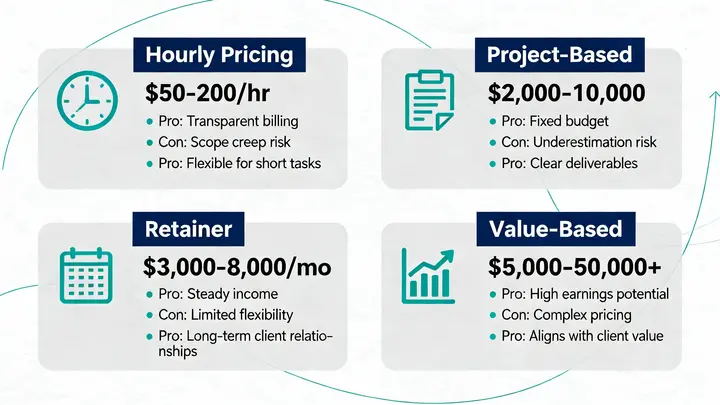
Test pricing regularly rather than locking into rates based on initial market research or early career positioning. Raise rates by 15-25% with each new client or project until you encounter resistance, then you’ve found your current market ceiling. Most freelancers discover they can charge substantially more than they initially believed, especially after building a strong portfolio and testimonials.
Marketing Your Freelance Services Effectively
Most freelancers rely entirely on marketplace platforms and hope clients find them, missing the higher-value opportunities that come from proactive marketing and positioning.
- You can establish expertise and attract clients searching for solutions to problems you solve using your blog content. Optimize your content for SEO and produce content that actually solves problems to build credibility.
- Publish case studies that help you market your website while building a portfolio.
- Build an email list of potential clients who aren’t ready to hire immediately but need services in the future. Attract such clients with free resources like a template, checklist, or guide in exchange for an email address. Nurture that audience with regular newsletters, case studies, and helpful resources.
X, formerly Twitter, is a great platform to share your results and build an email list. You can automate the process with tools like HypeFury or Manychat. You publish a post, and accounts that reply with a specific word get a lead magnet automatically.
Compare the best email marketing services to choose the one that fits your needs.
Another option is to build a landing page and add it to your bio on Instagram, TikTok, or Twitter. Then your content call to action is about that link on your profile.
Scale Beyond Trading Time For Money
The fundamental limitation of freelancing is that your income directly correlates with hours worked, creating an eventual ceiling on earnings without leverage beyond your personal time.
One way to scale is to raise your rates systematically as you gain experience and build your portfolio. Existing clients may continue at current rates through grandfather agreements, but every new client should be quoted your new higher rates. This vertical scaling increases income without additional hours.
Build systems and templates for recurring work to increase your effective hourly rate. If you design websites, develop template starting points for common project types. If you write content, create swipe files of effective introductions, structures, and transitions. These efficiency tools let you deliver equivalent quality in less time, increasing the gap between project fees and hours invested.
Develop digital products that complement your services and generate revenue without corresponding time investment. A social media consultant might create and sell courses, templates, or tools that clients can purchase separately or that serve as lead magnets for service work. These products provide scale potential while keeping you connected to your core expertise.
Build an affiliate business by recommending affiliate products to your clients. You can make passive income by promoting effective affiliate programs that pay recurring commissions.
One strategic move is to transition from selling services to building assets that generate passive income. I started as a freelancer and transitioned to be an affiliate blogger. I openly share this experience on AskEustache.
Tools and Resources for Selling Services Online
To be effective at selling services online, use software and resources to streamline operations and create professional client experiences without massive overhead.
Project management tools keep client work organized and demonstrate progress transparently. Asana, Trello, or Monday.com provide visual task tracking that you can share with clients for collaboration.
These platforms reduce confusion about project status, store all project communication in one place, and create accountability for both parties. Free plans work fine for solo freelancers, with paid tiers adding features as your business scales.
Time tracking software proves essential even if you don’t bill hourly because it reveals how long projects actually take versus estimates.
Toggl, Harvest, or Clockify let you track time by project and client, generating data that improves future project scoping and identifies profitable versus problematic project types.
This information proves invaluable for transitioning from hourly to project-based pricing.
Invoicing and payment processing need to be professional, but shouldn’t require expensive software. Wave offers completely free invoicing with reasonable credit card processing fees.
FreshBooks and QuickBooks provide more features for growing businesses that need expense tracking, reporting, and integration with other tools.
PayPal and Stripe provide payment processing if you want to collect payments through your website.
Video conferencing tools facilitate client communication and remote collaboration. Zoom remains the standard that most clients already use. Reliable video tools create professional interactions and reduce friction around remote work.
File sharing and collaboration platforms replace endless email attachments with organized workspaces. Google Drive works universally and offers collaboration features for documents, spreadsheets, and presentations. Notion creates all-in-one workspaces that combine documents, databases, and project management.
Learning resources keep your skills current and competitive. Industry blogs, YouTube channels, podcasts, and online courses provide ongoing professional development. Udemy offers affordable courses across most freelance disciplines.
Follow thought leaders in your niche, join relevant communities, and dedicate time weekly to learning rather than hoping your current skills remain sufficient.
What’s Next?
Freelancing provides a realistic path to location independence, schedule flexibility, and income potential that exceeds many traditional employment options.
The barriers to entry remain low, requiring only marketable skills and a willingness to consider your practice as a real business rather than a casual side activity.
Start by choosing services you can deliver competently, create a simple portfolio website showcasing your capabilities, and begin marketing through platforms, networking, and content creation.
Build experience and testimonials while gradually raising rates and transitioning to higher-value clients. Focus on creating such positive experiences that clients naturally refer others and return for additional projects.
Your expertise has value in the marketplace. Package it professionally, market it consistently, and deliver it excellently. The online economy continues expanding opportunities for skilled service providers willing to do the work of building real businesses rather than just chasing occasional gigs.
To build affiliate income by doing work for your clients, learn affiliate marketing strategies that can help you.
Join our email list to receive our educational content!

Latest Posts Under Selling Services as A Freelancer

5 Best Freelance Marketplaces to Find Online Jobs and Hire Talents
Find the best freelance marketplaces to find online jobs; vet and hire talents; collaborate wit strangers with tools that prevent fraud.

Earn Money With The Best Online Micro Jobs Websites
In this post you’ll learn how to make money with micro tasks and the best marketplaces to work with.

Online Translation Jobs: How, and Where to Get Paid to Translate at Home
If you know two languages well, you can make money with translation jobs online.

How to Get Paid Working At Home Your Ways With SeoClerks
Complete micro tasks and get paid working from home with SEOClerks. See how it works.

Learn How to Make HUGE Money Online With Freelancer
Freelancer.com is one of the most popular marketplaces for work-at-home jobs. Learn how to use it to make money online.

Make Money Working At Home – Build income from freelance jobs
Earn an income working at home with freelance jobs. Here’s what you need to know.