What Are Funnels in Digital Marketing?
In digital marketing, marketing funnels are a series of steps or pages leading visitors to convert into customers.
Eventually, you want the visitor to go through the four steps of a marketing funnel to buy a product. This can be done with a one-page funnel or a funnel built with multiple pages.
What are the 4 level of a marketing funnel?
The 4 levels of a conversion funnel are Awareness, Interest, Desire, and Action.
- Awareness: At this stage, the prospect is aware of or senses a problem that needs to be fixed and looks for possible solutions. Your strategy at this level is to create content addressing the issues and introducing your products.
- Interest: The prospect develops interest in a specific solution via newsletters and social posts. They review the product’s features and do comparisons to see if it’s the right choice.
- Desire: The prospect decides to investigate a specific product. They look at key features and what sets this product apart from the competition.
- Action: At this stage, the prospect decides to buy or not.
It’s also known as the AIDA funnel. It’s better when you look at it from the customer’s perspective.
A much simpler way to look at marketing funnel stages
You need to map your content for each stage of the funnel. That’s how your message will resonate with the prospect. You talk with words that matter to them at their current state.
Sometimes, the prospect will cross the Interest and Desire stages simultaneously. That’s why some marketers consider the three steps of their funnels:
- Awareness: Capture leads of people looking to identify a problem (problem-aware) or looking for a solution (solution-aware).
- Consideration: nurture your audience to show them why they should prefer your promoted product over others.
- Conversion: that’s when the prospect takes action. Give them trials, discounts, and bonuses to overcome objections.
Some companies consider loyalty as a stage of their marketing funnel, with steps to keep their existing customers.
Marketing Funnels Explained - How Does it Work?
A marketing funnel is a series of steps that lead to a conversion (sales, sign up, etc…). All these steps are connected together. It’s a system guiding the customer’s journey.
It’s called a funnel and not a tunnel because there’s a reduction of prospects at each stage down the road. The sales funnels connect the prospect with your product with:
- copy that speaks to them, highlighting what is in it for them.
- Ads that get their attention on your problem-solving products.
- landing pages that get them focused on your desired action.
- Email follow-ups that build a trust relationship with them.
Someone who is just at the top of the funnel, who has just discovered a problem, won’t spend money on a high-priced product. He’d need to review the options first to trust a product proven to solve the problem. He’d like to read reviews, see demos, etc. A sales funnel helps you guide the prospects through these stages.
You see!
You get better results when you create your marketing campaigns for a specific stage of the buyer’s journey.
Can you Give Me a Marketing Funnel Example?
A prospect notices that their phone is slow and looks for a solution online (Awareness). She finds out that a possible solution is to use cloud storage (Interest). She reviews different cloud storage services (Decision). See signs up for the best fit (Action).
As a business owner or affiliate marketer, you would create a page to help prospects looking for solutions (problem-aware). Then capture emails or direct them to review the best products (solution-aware). Then help the user decide to buy with a review of a specific product (Decision).
A simple conversion funnel goal may be lead generation, like:
- User sees a Facebook ad > You ask for email on the Landing Page > You get a conversion on email submit.
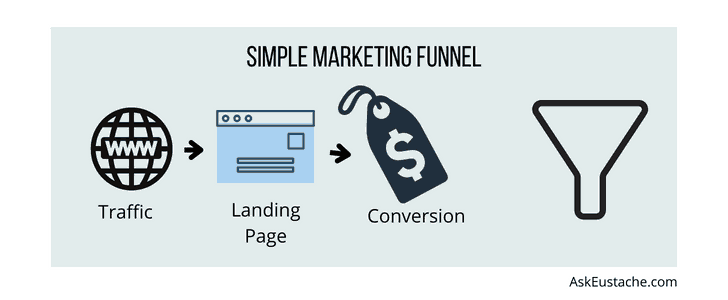
Then the prospect enters into an email marketing funnel to buy a product or multiple products.
Keep in mind that a prospect may convert at any stage of the funnel. Give them a way to buy every time.
Increase Revenue with Simple Yet Powerful Marketing Funnels
A good product helps fix the pain points of its potential buyers. Good marketing, through marketing funnels, gets your product in front of the right audience with specific campaigns.
Whether it is cold, warm, or hot traffic, you can convert them all. You can convert readers with Top of Funnel (TOFU), Middle of Funnel (MOFU), Bottom of Funnel (BOFU) content. You just need to create content for each stage of the funnel.
You can set up multiple funnels that work independently or are connected for upsells.
See my point?
You can increase sales with marketing funnels. They can help you get more customers, but also sell more products to existing customers.
On AskEustache, I focus on building sales funnels to sell affiliate products, but the same principles apply to funnels that sell your own products.
That’s how you build simple yet high-converting landing pages:
- Create a landing page to capture emails.
- Nurture your subscribers with well-written emails (SOAP opera sequences by example.)
- Give them reasons to buy your offers.
I go through the details in other posts.
What can you do to increase the conversion rate? Learn more…
- 7 Ways To Get More Engaging Email Subscribers.
- 3 Email Marketing Tools To Boost Conversion.
- Best Copywriting Techniques to Write Content That Sells.
- How to Increase Affiliate Sales on Your Blog?
- How to Hook Your Readers with Your Headlines?

Thanks for reading