Turn your ideas and digital files into physical products with a Print-on-demand business model.
I’ll show you how, along with thousands of designers, artists, and content creators, you can leverage existing platforms to make money selling print-on-demand products online. Start without inventory risks, manufacturing headaches, or upfront capital investment.
How Print on Demand Business Work?
As a way to make money selling online, print-on-demand operates on a simple fulfillment model that eliminates traditional inventory management.
You create designs and upload them to POD platforms, such as Printful, Printify, or specialized marketplaces like Redbubble.
When customers purchase your products, the platform receives the order, prints your design on the selected item, packages it, and ships it directly to your customer. You never touch the physical product.
It’s like you were selling digital products, but customers receive your digital assets printed.
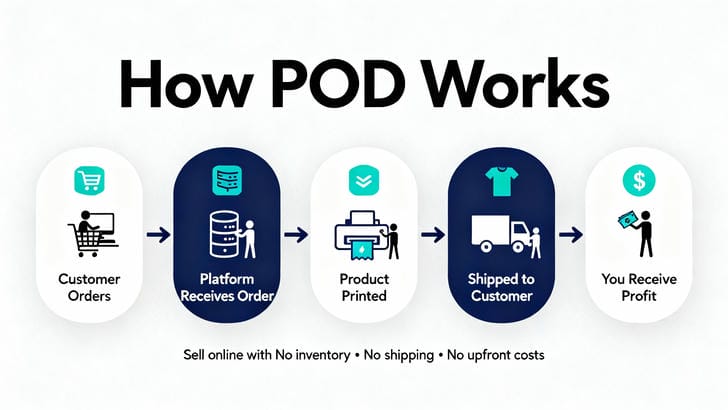
Your profit comes from the price difference between what customers pay and what the platform charges for production and shipping. If a t-shirt costs $12 to produce and ship, and you sell it for $27, you keep the $15 difference minus any marketplace fees or transaction costs.
Read our tutorial on designing and selling t-shirts online.
This on-demand production means you can offer hundreds of product variations without financial risk. Testing new designs, products, or niches costs nothing beyond your time creating the artwork. Poor performers simply remain unpurchased while successful products generate sales without requiring inventory predictions.
What POD Products Can You Sell?
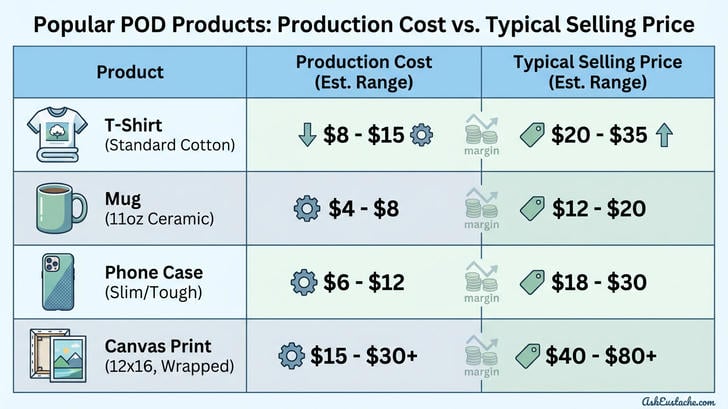
- Apparel: They dominate print-on-demand sales with t-shirts representing the most popular starting point. Hoodies, sweatshirts, and tank tops expand apparel offerings with higher price points and profit margins.
- Home décor products: Customized pillows, beach towels, canvas prints, and wall art appeal to customers seeking unique interior design elements. Add to that mugs, phone cases, and tote bags round out popular home and accessory categories.
- Books: With platforms like Amazon KDP, you can publish physical books without printing costs until customers order. You can sell planners, coloring books, and educational workbooks. One thing that I like is that you can start by selling the e-books and give the printed version as an option.
- Stickers: They offer surprisingly strong margins despite lower prices. Production costs run minimal ($0.50-2.00), shipping remains cheap, and customers frequently purchase multiple designs in single transactions. Design packs and themed collections particularly excel in sticker sales.
How to start with Print on Demand Business Online
Here’s everything you need to know about building a profitable print-on-demand business, from selecting your niche and products to marketing strategies that drive consistent sales.
Whether you’re launching your first store or scaling existing operations, you’ll find actionable guidance for creating sustainable POD income.
Choosing Your Print on Demand Niche
Selecting a niche is important, and it impacts everything from design creation to marketing effectiveness and long-term sustainability.
Successful POD niches balance three elements:
-
genuine personal interest that sustains long-term content creation,
-
sufficient audience size to support consistent sales,
-
and manageable competition that allows new stores to gain visibility.
Finding this intersection requires research beyond surface-level enthusiasm.
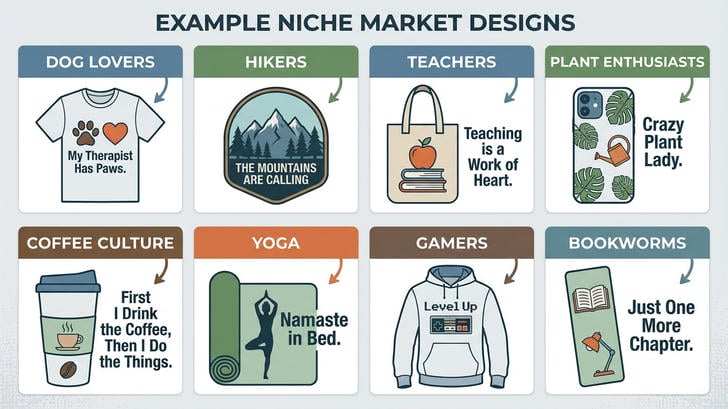
Here’s what you can do to find a profitable niche:
Evaluate niches by searching marketplace platforms for existing products. If there’s strong competition, this validates customer demand. You need to look for an angle for differentiation to manage competitiveness.
Go towards niches where the audience actively purchases custom products. A good example is dog lovers who famously buy multiple pet-themed products.
Choose a niche where you can produce dozens or hundreds of designs for apparel and home decor. For self-publishing books, look for a topic where your skills and knowledge can fix a specific problem for that audience.
Choose Among The Best Print on print-on-demand platforms
POD platform selection greatly impacts your product quality, profit margins, and operational efficiency.
Printful stands as the industry leader for integrated POD fulfillment, offering exceptional product quality, extensive integrations with major e-commerce platforms, and reliable customer service. Their white-label branding options, mockup generator, and warehouse locations in the US and EU create professional operations. Higher base costs compared to competitors get offset by consistent quality and reliability.
Printify operates as a print provider marketplace. You choose from multiple print facilities for each product type, comparing pricing and quality across suppliers. This competition creates better margins in many categories, though quality varies between facilities.
Gelato is good for high-quality art prints. It supports giclée prints, so your customers get your art printed with quality close to what you find in a museum, and durable.
Redbubble and Merch by Amazon function as POD marketplaces with built-in traffic. Customers discover and buy products through marketplace search and browsing. These platforms handle everything from production to customer service, but your profit margins shrink considerably (typically $2-8 per product). I use and recommend these channels for passive income rather than primary business foundations.
Amazon KDP (Kindle Direct Publishing) specifically serves book publishing, offering paperback and hardcover print on demand alongside ebooks. KDP’s integration with Amazon’s marketplace provides unmatched book distribution, though margins remain modest (typically 40-60% of list price minus printing costs).
To keep your customers happy and your business thriving, choose platforms with high-quality products, profit margin potential, customer service quality, and shipping speed and reliability.
Create Winning Print on Demand Designs
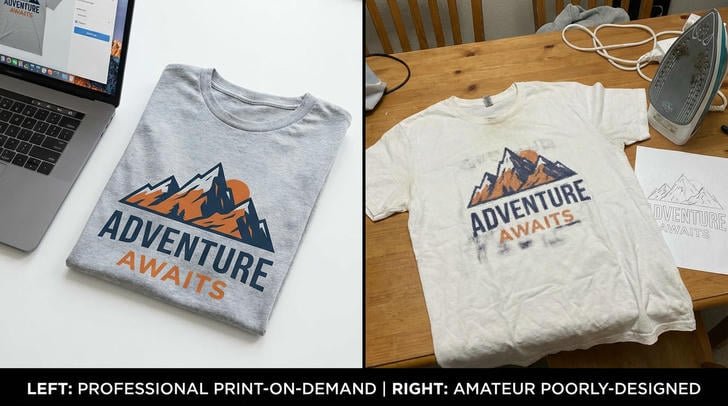
You can create quality designs without artistic skills. However, knowing how to leverage tools to make them appealing is crucial. Design quality separates profitable POD stores from abandoned storefronts with minimal sales.
Typography-based designs, clever text phrases, and simple graphic elements often outperform complex illustrations. Many top-selling products feature nothing more than witty sayings in attractive fonts with complementary layouts.
While it is forbidden to copy someone else’s design, research successful designs in your chosen niche to identify color schemes, design styles, message types, and layouts. Non-designers can use tools like Canva to create graphic designs or use
AI tools such as Leonardo AI (which I use). The pros can use Illustrator, Photoshop, and GIMP for more advanced options. Another option is to outsource design work with freelancers on platforms like Fiverr.
Suggested read: Graphic Design Software For Content Creators.
To keep up with demand and remain profitable, create designs for trends that result in short-term sales spikes, and evergreen designs that sell consistently year-round.
Important Design Guidelines
- For text-based designs, select professional fonts and combine them thoughtfully. Give the text enough size to remain readable.
- Ensure high-quality printing by uploading images with thick lines and high resolution. 300 DPI minimum is required by most platforms. It’s simple: quality in, quality out.
- Create high contrast, bold designs that stand out. Ensure the colors the buyers see on screen match the ones printed. There are more colors that a screen can display (RGB) than a printer can print (CMYK) for most scenarios.
- Create original work. Never use brand logos, trademarked phrases, or celebrity images without licensing.
Upload your Design and Price to profit
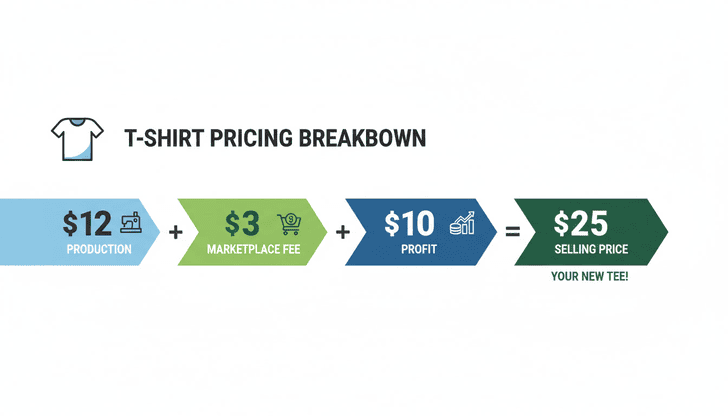
It’s important to fix a price for your design so it impacts your profit margins, sales velocity, and brand perception positively.
Most POD businesses price products using a 2-3x markup over base costs, though niche-specific factors shift these ratios. A basic t-shirt with simple text might justify $22-28, while unique designs in passionate niches command $30-40. Specialized products or limited collections can demand premium pricing when positioned correctly.
Dramatically underpricing suggests inferior quality and leaves money on the table. Substantially overpricing without clear differentiation suppresses sales volumes. Find the range where your audience comfortably purchases while maintaining healthy margins.
Product quality and platform choice influence pricing latitude. Customers accept higher prices for superior products from trusted fulfillment partners. If you’re using premium blanks with excellent printing from Printful, communicate this quality to justify higher prices compared to competitors using budget options.
Marketing Your Print on Demand Business
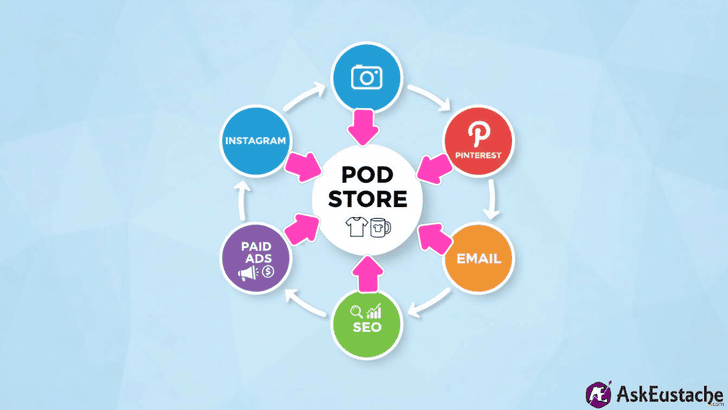
To generate consistent sales and sustainable growth, you need to actively promote your POD Business. There are effective strategies to sell t-shirts online using free promotion.
The primary traffic source for most POD businesses is organic social media.
Platforms like Pinterest, Instagram, and TikTok showcase visual products effectively while building engaged communities around your niche.
Post designs regularly, share behind-the-scenes content, engage authentically with followers, and use relevant hashtags to expand reach.
I particularly like Pinterest for marketing print-on-demand products. It’s a visual search engine where you get access to the keywords buyers are using to search for products on the platform. Optimizing a profile, boards, and pins for such keywords can help you drive consistent sales.
Other options for promotion include email marketing, SEO for your store, content marketing, and paid advertising.
Marketplaces like Redbubble already have built-in traffic; You can leverage this to make passive income selling shirt designs. However, you need to actively upload new designs as marketplace algorithms favor listings with strong engagement metrics, relevance, and freshness.
Scale Your Print on Demand Business
Here are different methods to scale your print-on-demand online business:
- Build multiple niche stores to diversify income streams. After mastering POD operations in one niche, replicate the model in different markets. Each store operates independently, reducing risk from algorithm changes, trend shifts, or niche saturation affecting any single store.
- Offer your design on different marketplaces. You can upload the same design on different platforms as long as you’re the author behind it. Some customers have a platform preference you need to take into account to reach more people.
- Outsource design creation or master prompts to leverage AI tools. Hire freelance designers through platforms like Upwork or Fiverr to execute your creative direction. Provide clear briefs, style guides, and examples while maintaining quality control through approval processes.
Print on Demand vs Traditional E-Commerce
Traditional e-commerce requires purchasing inventory upfront, storing products, and handling shipping logistics yourself. There is a risk of unsold products eating into profits.
Print on demand eliminates these challenges. No inventory purchases, no storage facilities, no packing and shipping operations. The startup costs might just include design software, a domain name. Still, free alternatives exist.
But because you don’t benefit from volume discounts with one-off production of your POD products, traditional inventory-based e-commerce businesses offer substantially higher profit margins.
Another distinction is control and quality.
With inventory-based businesses, you inspect products before shipping, ensuring consistent quality. Print on demand puts quality control in your fulfillment partner’s hands. That’s why it’s crucial to partner with brands with high-quality standards.
Choose Print on Demand when minimizing risks and capital investment matters, ensuring you find a partner you can trust.
The trade-off for this convenience is lower profit margins compared to bulk manufacturing and longer shipping times than traditional e-commerce has conditioned customers to expect.
POD products typically take 5-10 business days to produce and deliver, requiring clear communication about fulfillment timelines.
Frequently Asked Questions About Starting a POD Business
How much money can I realistically make with print-on-demand?
Income varies enormously based on niche selection, design quality, marketing effectiveness, and time investment. Complete beginners often make nothing for their first 3-6 months while building product catalogs and learning marketing. With consistent effort, earning $500-2,000 monthly represents an achievable goal within 6-12 months for most niches.
Your income potential grows as you expand product lines, build email lists, improve conversion rates, and develop multiple traffic sources. The compounding nature of POD means month 24 looks dramatically different than month 6 for businesses that persist through initial learning curves.
Do I need to be a designer or artist to succeed in print on demand?
Artistic skills help but aren’t required for POD success. Many profitable stores sell text-based designs, clever phrases, or simple graphic combinations requiring minimal illustration ability. Tools like Canva democratize design through templates and elements anyone can combine into attractive products.
How much does it cost to start a print on demand business?
You can start a print-on-demand business for free. The first startup costs might include a domain name ($10-15 annually), Shopify subscription ($29 monthly). But options exist to start a POD stores completely free with Printify or GearLaunch.
Marketing budgets vary dramatically based on your strategy. Organic social media and SEO require time rather than money, while paid advertising demands testing budgets of $300-1,000 to identify profitable campaigns. Most successful POD businesses reinvest early profits into expanded marketing as they grow.
Is print on demand still profitable in 2026, or is the market too saturated?
Print on demand is still profitable in 2026. The market may be satured for broad and generic categories but sellers who identify specific audience and create quality products thrive in these profitable niches.
Profitability depends more on your execution than market saturation. Businesses that identify underserved niches, create appealing designs, and market effectively remain profitable regardless of broader market conditions.
Your Next Steps in POD Online Business
- Start by selecting your niche through careful research balancing personal interest, audience size, and competition levels. Choose one or two core products like t-shirts and mugs that allow testing designs without overwhelming yourself with complexity.
Building a profitable POD business requires more patience than most entrepreneurs expect but less capital and risk than traditional product businesses demand.
Launch your products and begin marketing through your chosen channels. Post consistently on social media, publish content if using SEO, or test small paid advertising campaigns. Marketing consistency matters more than any single tactic or viral moment.
Join our email list to receive our educational content!

Latest Posts Under Print-on-Demand Business
Top Print on Demand Sites That Accept Payoneer in 2026 (Ranked & Reviewed)
Discover the best print-on-demand sites that accept Payoneer in 2026. Compare payout options, features, and top platforms for creators and eCommerce sellers.

Effective Strategies To Sell Shirts With TeeSpring & ViralStyle
You can make an income selling t-shirt designs online. We’ll discuss here free methods to get buyers for your designs.
Best Graphic Designer Software
Visual gets you understood and drive traffic to your blog. You need graphic design tools that help you create images fast.
How To Design And Sell T-shirts Online Without Investment
Learn how to design and sell t-shirts online. In fact, you don’t have to be a designer. Learn how.