Starting an online business transformed my life in 2013, though my journey began with GPT sites where I traded hours for pennies.
The real breakthrough came when I shifted to building sustainable income streams through blogging, affiliate marketing, and selling products online. What started as side income eventually became my full-time income.
Most beginners dive straight into creating websites or products without understanding their market. They spend months building something nobody wants, then wonder why sales never materialize.
This complete yet beginner-friendly guide will demonstrate step by step how to start an online business that generates real income.
Why Start an Online Business?

The online business landscape offers opportunities that traditional employment cannot match.
- Location independence means working from anywhere with internet access. You’re not tied to a physical office or specific geography.
- Your business operates 24/7, generating income while you sleep, travel, or spend time with family. Therefore, online businesses scale beyond your personal time investment through automation, digital products, and affiliate relationships that compound over time.
- Low startup costs represent another massive advantage. Unlike brick-and-mortar businesses requiring tens of thousands in capital, many online companies launch for under $100. We’ll even uncover business ideas you can start without monetary investment.
The barrier to entry keeps dropping. Free tools now handle tasks that once required expensive software or technical expertise. You can build professional websites, create content, manage email lists, and process payments using platforms that cost nothing upfront.
Understanding Market Research Before You Start
Market research determines whether your business idea has genuine demand or represents wishful thinking.
Most failed online businesses share a common story. Someone builds something they think is cool, invests months of effort, then discovers nobody actually wants to buy it.

[!TIP]
Research first, build second.
Start by exploring online communities where your potential customers already gather. Reddit communities, Facebook groups, Discord servers, and niche forums reveal what people actually discuss, struggle with, and spend money solving.
Read through discussions looking for patterns. What questions appear repeatedly? Which problems generate the most engagement? What solutions do people recommend to each other? This qualitative research uncovers real pain points that represent business opportunities.
Keyword research tools provide quantitative validation. Free tools like Google Keyword Planner, AnswerThePublic, and Ubersuggest show search volume for topics you’re considering. High search volume indicates existing demand; you’re not creating a market from scratch.
Pay attention to commercial intent keywords. Searches like “best email marketing software” or “how to start affiliate marketing” signal people ready to spend money solving problems. Informational searches like “what is email marketing” attract researchers who may not buy yet.
Step-by-Step Process to Start Your Online Business
Identifying Your Profitable Niche
Your niche determines everything about your online business, from content creation to monetization strategies.
Broad topics like “health” or “finance” attract massive competition from well-funded companies. But it’s difficult to outrank established authorities with unlimited budgets.
Choose a niche or a segment of that audience to reduce competitiveness. Narrow focus creates a competitive advantage through specialization.
In fact, money opportunities are in the niches.
For example, “Fitness” is too broad a topic. You attract an audience with mixed intent, thus a lower conversion rate. “Strength training for women over 40” gives you a specific, underserved audience with distinct needs. This narrower focus makes marketing easier, content creation more precise, and monetization more effective.
Start by listing topics you understand deeply through education, career experience, or personal interest. Your knowledge creates content credibility and sustains motivation during the inevitable challenges of building a business.
Evaluate each potential niche against three criteria: your expertise, market demand, and monetization potential.
- Expertise means you can create valuable content without extensive research for every article. You understand the challenges your audience faces because you’ve lived them or solved them professionally.
- Demand requires existing search volume and active communities. Use Google Trends to confirm interest remains steady or grows over time. Declining trends signal dying markets that won’t sustain long-term business growth.
- Monetization potential involves multiple income streams. The best niches support blogging revenue, affiliate programs, digital products, and services. Single-revenue niches limit your income ceiling and create vulnerability if that channel changes.
Consider the competition level realistically. Zero competition usually means no demand exists. Massive competition from billion-dollar companies means you need exceptional differentiation. Moderate competition with mostly amateur or outdated content presents ideal opportunities.
Look for niches where you can become a recognized authority within 12-18 months of consistent effort. This timeline balances quick wins with sustainable positioning that generates long-term income.
The intersection of passion and profit matters tremendously. You’ll create thousands of pieces of content, answer hundreds of questions, and solve countless problems. Choose a niche you can discuss enthusiastically for years without burning out.
Choosing Your Business Model
Select a business model based on your current situation, skills, and goals rather than chasing trends or get-rich-quick schemes.
Consider how much time you can invest weekly.
- Blogging or vlogging requires consistent content creation but builds compound returns.
- Affiliate marketing needs upfront work, creating reviews and comparisons, but generates ongoing passive income.
- Services exchange time for immediate money but hit scaling limits.
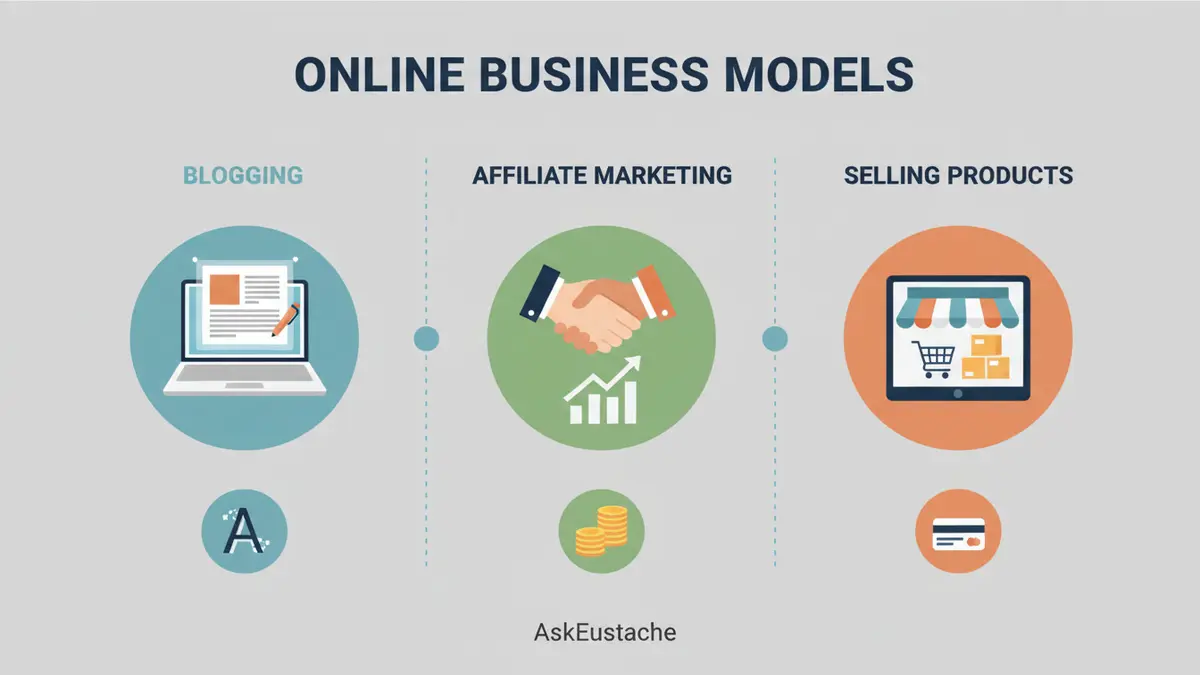
Let’s explore each of these business models.
Three Core Online Business Models
Online businesses generally fall into three categories: blogging for income, affiliate marketing, or selling products and services.
Each model requires different skills, time investment, and monetization approaches. Understanding these differences helps you choose the path matching your goals, resources, and personality.
Most successful entrepreneurs eventually combine multiple models. They start with one, master it, then layer additional income streams. This diversification creates more stable, recession-resistant businesses.
Building a Blogging Business
Blogging generates income through advertising, sponsorships, and content monetization while building an audience that supports other business models.
When you learn how to blog to make money, your blog becomes a platform for demonstrating expertise, attracting an audience, and creating multiple revenue streams. You can then leverage content marketing to drive traffic, establish authority, and convert readers into customers.
The blogging business model requires consistent content creation. You’ll publish articles, optimize for search engines, promote content across social media, and engage with readers regularly. This time investment builds compound returns as your content library and audience grow.
Learn Blogging Tips to grow faster using effective content and marketing strategies.
You’ll then make money blogging with display advertising, sponsored content, premium memberships, and by using your blog as a platform to sell other products or services.
Skills needed for blogging:
- Content writing and basic SEO
- Social media marketing
- Email marketing basics
- Basic website management
- Community building
Building an Affiliate Marketing Business
Affiliate marketing involves promoting other companies’ products and earning commissions on resulting sales.
This business model requires no product creation, inventory management, or customer service. You focus entirely on connecting audiences with solutions they need, earning percentage-based commissions when people purchase through your unique affiliate links.
My biggest career shift came from recognizing the power of recurring affiliate programs. Discovering tools like Kit (formerly ConvertKit) and Cloudways changed everything. One customer you refer to these platforms keeps paying commissions for years as they continue their subscription.
While high-ticket affiliate sales provide nice paydays, recurring revenue is what actually allows you to sleep at night knowing your bills are covered. Building a portfolio of customers subscribed to monthly services creates predictable, growing income that compounds over time.
Successful affiliate marketing starts with choosing products you personally use and genuinely recommend. Your credibility depends on honest recommendations.
Skills needed for affiliate marketing:
- Content creation (writing or video)
- SEO and keyword research
- Persuasive copywriting
- Basic analytics
- Email marketing
Free tools for affiliate marketing:
- AAWP or Lasso (display box to increase CTR)
- ConvertKit free plan (email marketing for up to 10,000 subscribers)
- Google Search Console (search performance tracking)
Many affiliate programs are free to join. Amazon Associates, PartnerStack, CJ Affiliate, and Impact all allow beginners and pros to apply. Software companies often run their own affiliate programs with generous commissions.
Selling Products and Services Online
Creating and selling your own products or services generates the highest profit margins and builds a business you fully control.
Digital products, print-on-demand items, and service offerings each represent viable business models with different benefits and challenges.
Digital products include ebooks, online courses, templates, software, membership sites, and downloadable resources. Once created, each sale costs virtually nothing to fulfill, resulting in profit margins approaching 100%.
The upfront time investment in digital products can be significant. Developing a comprehensive course might take 40-80 hours. However, that product then sells repeatedly with minimal additional effort, creating passive income that scales beyond your personal time.
Print-on-demand eliminates inventory risk by producing physical products only after customers order. Services like Printful, Printify, and Redbubble handle manufacturing, storage, and shipping. You design products, they fulfill orders, and you earn profit from the difference.
Freelance services exchange your skills for direct payment. Writing, design, development, consulting, coaching, and virtual assistance all operate on service models. Income depends on hours available, but services often provide the fastest path to first revenue.
Service businesses can evolve into productized offerings. Once you’ve delivered the same service repeatedly, you understand the process deeply. Package that knowledge into templates, systems, or courses that serve more people without linear time investment.
Skills needed for selling products:
- Content creation (for digital products)
- Design basics (for physical products)
- Pricing and positioning
- Sales copywriting
- Customer service
- Payment processing setup
Free tools for selling online:
- Gumroad (free to start, 10% + payment fees)
- Payhip (free plan available)
- Canva (free design for digital products)
- Lemon Squeezy (free to start)
For services, start with your existing network and free platforms. LinkedIn, your personal website, and niche communities can generate your first clients without advertising costs. Many successful freelancers build six-figure businesses without paid ads.
Other Criteria for Choosing An Online Business Model
Evaluate your existing skills honestly. Strong writers excel at blogging and affiliate content. Designers thrive in creating digital products or print-on-demand items. Subject matter experts can command premium rates for coaching or consulting services.
Financial runway matters significantly. Service businesses generate income fastest, sometimes within weeks of starting. Blogging and affiliate marketing typically take 6-12 months before substantial income materializes. Digital products sit somewhere in between, depending on your audience size when launching.
Most entrepreneurs benefit from a hybrid approach. Start with services to generate immediate income while building a blog that attracts an audience. Layer in affiliate recommendations for products you actually use. Eventually, create digital products that scale beyond hourly limitations.
The business model you choose isn’t permanent. Start somewhere, learn from experience, adjust based on results. Many successful online entrepreneurs completely pivoted their business model after discovering what actually worked for their situation.
Building Your Online Presence
Every online business needs a home base you own and control completely.
Social media platforms can disappear, change algorithms, or ban accounts without warning. Email providers can restrict access. But your own website remains yours, hosting content that serves your business for decades.
Choose a memorable domain name that relates to your niche without being too narrow. AskEustache works because it suggests asking an expert while leaving flexibility for various topics. Avoid domain names so specific that they limit future growth directions.
Self-hosted WordPress provides the best foundation for most online businesses. It costs $3-10 monthly for basic hosting and gives you complete control over design, functionality, and monetization. The learning curve is manageable for beginners, with countless free tutorials available.
Essential pages for any online business website include a clear homepage that explains what you do, an about page building trust through your story, a contact page making it easy to reach you, and a getting started or resources page directing new visitors to your best content.
Start simple rather than waiting for a perfect design. Launch with a clean, professional theme and improve iteratively based on user feedback and analytics. Your first version won’t be perfect, and that’s completely fine. You can refine continually as your business grows.
Content Creation Strategy
Content drives discovery, establishes expertise, and converts visitors into customers across all online business models.
Quality beats quantity consistently. One deeply researched, comprehensive article providing real value attracts more traffic and engagement than ten superficial posts covering the same topic shallowly.
Focus your content calendar around your audience’s questions and search queries. Use tools like AnswerThePublic, Google’s “People Also Ask” sections, and Quora to discover what people actually want to know in your niche.
Create pillar content that comprehensively covers core topics in your niche. These 3,000-5,000-word guides target high-value keywords and serve as reference resources that attract links and rank well in search results for years.
Support pillar content with cluster articles covering subtopics in more depth. This internal linking structure helps search engines understand your expertise while giving readers paths to explore related topics.
Consistency matters more than frequency. Publishing one quality article weekly that you can sustain indefinitely beats publishing daily for a month, then burning out. Set realistic schedules you’ll maintain for years.
Repurpose content across platforms strategically. A comprehensive blog post can become a YouTube video, a series of social media posts, an email newsletter, and a podcast episode. This multiplies your content’s reach without creating everything from scratch.
Building Your Audience
Traffic and audience represent the fuel for any online business, regardless of business model.
Search engine optimization (SEO) provides the foundation for sustainable traffic growth. Optimize content around specific keywords, earn backlinks from reputable sites, and improve technical site performance. SEO results compound over time as your content library grows and authority increases.
Email marketing remains the highest ROI channel for online businesses. Unlike social media, where algorithms control visibility, your email list represents a direct line to interested people. Start collecting emails from day one, even with just a simple content upgrade or newsletter signup.
Social media amplifies reach and accelerates growth, but shouldn’t be your primary traffic source. Choose one or two platforms where your audience actively engages rather than trying to maintain a presence everywhere. Quality engagement on fewer platforms beats superficial posting across many.
Monetization Strategies
Multiple income streams create more stable, recession-resistant online businesses than relying on single revenue sources.
Diversification protects against platform changes, market shifts, and seasonal fluctuations. If one income stream drops 50%, three others continue supporting your business rather than facing catastrophic income loss.
Start with one monetization method, optimize it until profitable, then layer additional streams. Trying to do everything simultaneously usually results in mediocre performance across all channels rather than excellence in any.
For bloggers, begin with affiliate recommendations embedded naturally in content. As traffic grows to 2,000+ monthly sessions, apply for premium ad networks like Ezoic or Journey by Mediavine. Create your first digital product once you understand your audience deeply.
Affiliate marketers should diversify across multiple programs and product types. Combine high-ticket, one-time sales with recurring commission programs. This balance provides a consistent monthly income plus occasional larger payments.
Product creators benefit from offering multiple price points. A $27 ebook, a $197 course, and a $2,000 coaching program serve different customer segments. The low-priced product attracts many customers and introduces them to your expertise. The premium offering generates substantial revenue from fewer sales.
Service providers should document their processes and create productized versions of frequently delivered work. This transition from pure service to scalable products typically takes 12-24 months but transforms income potential dramatically.
Common Mistakes to Avoid
Most beginners make predictable mistakes that delay success and waste resources.
Perfectionism paralyzes progress. Your first website, content, and products won’t be perfect. Ship them anyway, gather feedback, and improve iteratively. Every successful entrepreneur launched imperfect work and refined it based on real-world results.
Chasing every opportunity dilutes focus and prevents mastery. Stick with one business model and niche long enough to see results before jumping to the next shiny object. Success requires at least 6-12 months of consistent effort in one direction.
Neglecting email list building from day one represents a massive missed opportunity. Even with just 100 engaged subscribers, you have a direct communication channel that doesn’t depend on algorithms or platforms you don’t control.
Underpricing products or services leaves money on the table and attracts difficult customers. Higher prices filter for committed buyers who value your work and implement your advice rather than collecting cheap courses they’ll never finish.
Copying competitors instead of developing unique perspectives makes you invisible. Study successful examples to understand what works, then create something distinctly yours that showcases your unique experience and voice.
Ignoring analytics means flying blind without knowing what’s working. Install Google Analytics and Search Console from day one. Review performance monthly to identify what content attracts traffic, what converts visitors, and where improvements create the biggest impact.
Scaling Your Online Business
Growth requires different strategies than starting.
Once you’ve established consistent traffic and initial revenue, focus on optimization before expanding. A profitable business earning $2,000 monthly often has more upside from improvement than from launching entirely new ventures.
Analyze your top-performing content to understand what resonates. Create more content covering similar topics or related keywords. This focused approach typically outperforms random content creation, hoping something hits.
Improve conversion rates through split testing. Small changes to email opt-in forms, call-to-action buttons, pricing pages, and checkout processes often increase revenue 20-50% without requiring additional traffic.
Outsource repetitive tasks once you’ve documented processes clearly. Virtual assistants can handle formatting, scheduling, uploading, and administrative work that consumes your time without requiring your specific expertise.
Create systems and templates for recurring activities. Email sequences, content outlines, product launch checklists, and standard operating procedures reduce decision fatigue and ensure consistent quality.
Develop strategic partnerships with other creators in your niche. Guest posting, collaboration projects, bundle offers, and cross-promotion expand reach faster than solo efforts.
Consider creating a signature product or program that represents your core expertise. This higher-priced offering serves customers ready for deeper engagement and generates more revenue per sale than entry-level products.
Long-Term Sustainability
Building an online business that lasts requires attention to factors beyond initial launch success.
Diversify traffic sources to reduce platform dependence. Email marketing, search traffic, social media, and referral partnerships should all contribute to overall visitor numbers. Over-reliance on any single channel creates vulnerability when changes happen.
Maintain consistent content creation even after achieving initial success. The websites that dominate search results five years from now will be those still publishing valuable content regularly, not those that stopped after reaching first page rankings.
Stay current with industry changes while maintaining core strategies. SEO best practices evolve, social platforms rise and fall, but fundamental principles of providing value and building relationships remain constant.
Build genuine relationships within your industry. These connections provide support during challenges, opportunities for collaboration, and insights into emerging trends. Treat other entrepreneurs as colleagues rather than competitors.
Plan for automation and scaling from the beginning. Design systems that work without your constant involvement. This enables you to eventually step back from day-to-day operations while maintaining income.
Most importantly, create a business aligned with your desired lifestyle rather than optimizing purely for revenue. An online business should support the life you want to live, not consume it entirely. Define success on your terms, not through comparison with others’ external results.
Frequently Asked Questions
How much money do I need to start an online business?
You can start an online business for under $100. The minimum investment includes a domain name ($10-15 annually) and basic hosting ($3-10 monthly). Free tools handle most other functions when starting.
For a blog, the must is a domain name because you can leverage free hosting. For a print-on-demand business, you can grow profitably completely free.
The main investment is your time rather than capital.
However, having a small budget for premium tools accelerates growth. Investing $50-100 monthly on quality hosting, email marketing, and essential software provides a better experience than relying entirely on free alternatives.
How long does it take to make money from an online business?
Service-based businesses can generate income within 2-4 weeks. If you’re offering freelance skills, initial clients often come from personal networks and require minimal setup time.
Blogging and affiliate marketing typically take 6-12 months before substantial income materializes. You need time to create content, build traffic, establish authority, and develop audience trust before significant monetization occurs.
Digital product businesses fall somewhere in between, depending on your existing audience. Launching a product to an engaged email list can generate revenue immediately. Building the audience first takes time.
Set expectations for a 12-month runway before expecting your online business to replace a full-time income. Some achieve it faster, many take longer, but planning for a year of consistent effort provides realistic timeframes.
Can I start an online business while working full-time?
Absolutely. Most successful online entrepreneurs started while employed, using evenings and weekends to build their businesses.
Working full-time actually provides advantages. You have income security while testing business ideas, no pressure to monetize before finding product-market fit, and time to learn fundamentals without financial stress.
Dedicate 10-15 hours weekly to your online business during this phase. This typically means 1-2 hours on weekday evenings and 5-8 hours over weekends. Consistent effort matters more than massive time blocks.
Focus on activities that move the business forward rather than on perfectionism. Create content, reach out to potential customers, launch imperfect products, and iterate based on feedback. Progress beats polish when building with limited time.
What’s the best online business model for beginners?
Service businesses offer the fastest path to first revenue. If you have marketable skills, freelancing through platforms like Upwork or direct outreach to potential clients can generate income within weeks.
Blogging combined with affiliate marketing provides the best foundation for long-term passive income. The time investment is higher initially, but the content you create today continues attracting traffic and earning commissions for years.
The “best” model depends on your situation. Need income immediately? Choose services. Have time to build for the long term? Start blogging and affiliate marketing. Want creative outlets? Consider digital products or print-on-demand.
Most entrepreneurs eventually combine multiple models. Start with one, establish momentum, then layer additional income streams once you’ve proven the first approach works.
Do I need technical skills to start an online business?
Basic technical proficiency helps, but you don’t need coding knowledge or advanced technical skills to launch successfully.
Modern website builders and platforms handle most complexity automatically. WordPress, for example, requires no coding. You can install themes, add content, and publish professionally without touching code.
The technical skills most valuable are researching solutions independently, following tutorials carefully, and troubleshooting basic issues. These meta-skills apply across all platforms and tools.
Start with your current skill level and learn incrementally as needs arise. YouTube tutorials, documentation, and community forums answer most questions beginners encounter. You’ll become more technically capable simply through solving problems as they appear.
Consider hiring specialists for truly complex tasks. A freelance developer can handle custom functionality for $100-500, often cheaper than spending weeks learning skills you’ll rarely use again.
Start Building Your Online Business Today
You now understand the complete process of starting an online business from market research through scaling.
Now it’s time to take action.
Join our email list to receive our educational content!

Latest Posts Under Online Business
Online Business Growth Guide For Content Creators
Welcome to your one-stop resource for growing an online business. Whether you’re just starting or looking to scale, find the guides, tools, and insights to help you succeed.

15 Ways to Make Money Online (with Passive Income Opportunities)
Learn how to make money with a system you can scale. Find online money-making methods with passive income opportunities.

The Complete Guide to Monetizing Your Content in 2026
Millions of people are turning their content into thriving businesses. This creator’s guide to content monetization will teach you how to do it at scale.

Payoneer Partners: List Of Money Making Programs That Pay Via Payoneer
In some places, Payoneer is one of the best options to receive payments. Here are some Payoneer partners you can work with.
The Best Online Business Ideas to Start in 2026 (That Actually Work)
Find a list of high-profit online business ideas you can start without investment. Suitable for beginners, students, or experienced work from home entrepreneurs.
Best 7 Online Passive Income Ideas in 2026 You Can Start Now
Here some passive income ideas to make money online. You do the work upfront and reap the benefits later.